
Cut a banana in half and look for the seeds. There is a line of tiny black specks down the middle and nothing else. Those specks are seeds that never developed, and they never will. The banana in your kitchen cannot reproduce.
Wild bananas manage it easily. Musa acuminata, the ancestor of most cultivated varieties, grows fruit packed with hard seeds the size of peppercorns. There is more seed than flesh in there, and biting into one is closer to chewing gravel than to dessert.
Farmers in New Guinea started selecting the odd seedless mutants at least 7,000 years ago. Those plants set fruit without pollination, a trick that also left them sterile. So the only way to get another one was to cut off a shoot and plant it. Every banana grown since has come from a cutting of a cutting of a cutting.
A banana plantation, in other words, is not a population. It is one plant, copied a few million times.
Wild bananas are so full of hard seeds that people eat the flower and the stem instead of the fruit. The seedless version we buy exists because of a mutation that made the plant sterile, which is why it has been propagated by cuttings for thousands of years.
The banana that already died
From the 1870s until the 1950s, the banana on sale in New York and London was not the one on sale today. It was the Gros Michel, Big Mike, a larger and sweeter fruit with a peel thick enough to survive a sea crossing without much padding. United Fruit built an empire on it, along with the railways, ports and politics that gave the phrase "banana republic" its meaning.
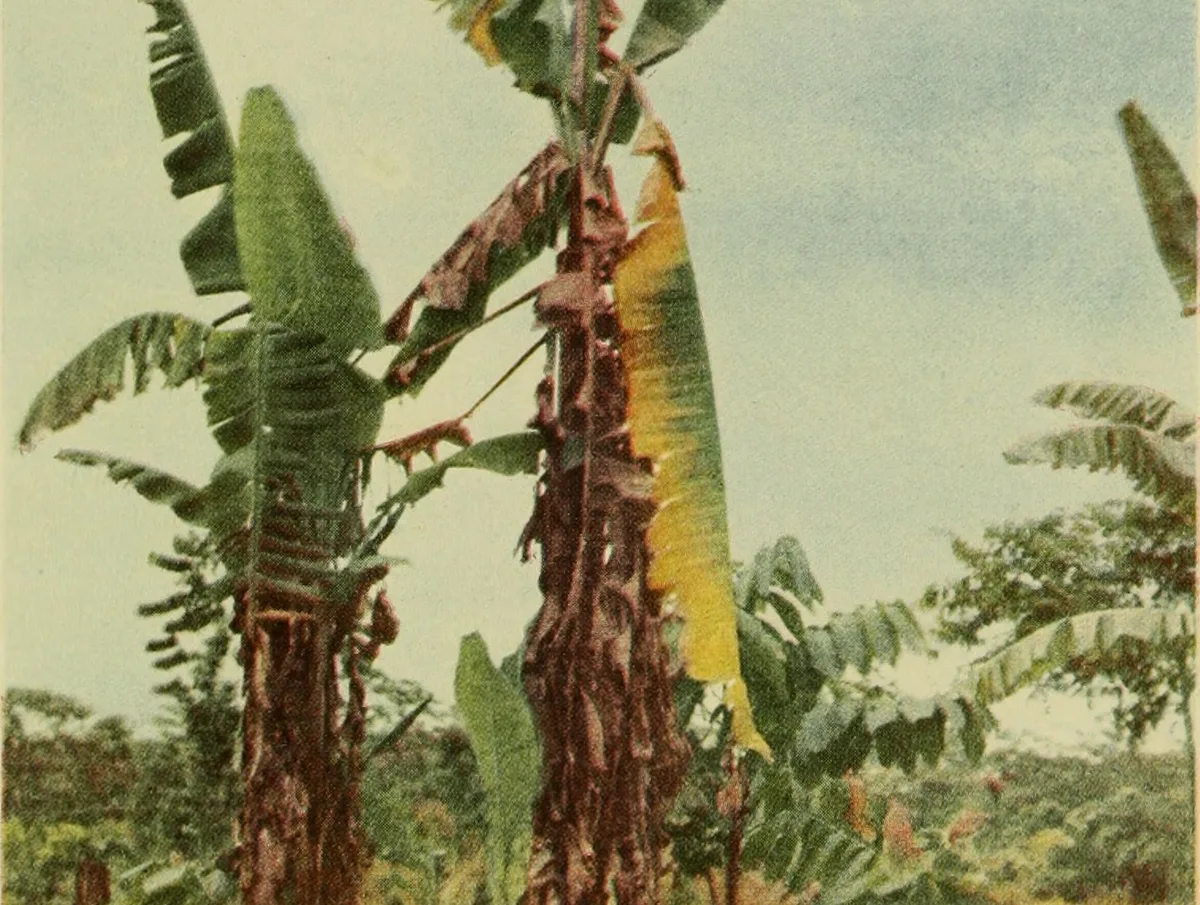
Then the soil turned against it. A fungus called Fusarium oxysporum f. sp. cubense enters the plant through the roots, blocks the vessels that carry water, and the leaves collapse into a brown skirt around the stem. Growers called it Panama disease. By 1919 the US plant pathologist Elmer Brandes was publishing color plates of dead Gros Michel plants in Costa Rica, which is the photograph at the top of this article.
Nothing stopped it. Plantations were abandoned, the companies moved to clean land, and the fungus followed. By the mid-1960s the Gros Michel was finished as an export crop.
What saved the trade was a different clone. The Cavendish resisted that strain of the fungus, and between the 1950s and the 1960s the industry tore out Big Mike and replanted with it. The new fruit was smaller, blander and bruised if you looked at it wrong, so the whole shipping system had to be rebuilt around cardboard boxes instead of hanging stems. The banana got worse and the business went on.
The Gros Michel is not extinct. It still grows in gardens and on small farms, and it sells in Thailand as kluai hom thong and in Indonesia as pisang ambon. It lost the global banana trade, not its existence.
A greenhouse in Derbyshire
The clone that took over the world has an address. In 1830 Joseph Paxton, head gardener at Chatsworth House, got hold of a banana plant imported from Mauritius and put it under glass in the Derbyshire cold. It flowered in 1835 and fruited the following May, and one of the bananas won a medal at a Horticultural Society show.
Paxton named the plant Musa cavendishii after his employer, William Cavendish, 6th Duke of Devonshire. A few years later the Duke gave two cases of plants to a missionary bound for the South Pacific. One case survived the voyage and started the banana industry in Samoa. Chatsworth claims that almost every banana eaten in the Western world descends from that one plant, which is the house telling its own best story, though the name at least is beyond dispute.
The flavor myth
Banana candy tastes like a banana the way a police siren sounds like a wolf. The popular explanation is that the flavor was modeled on the Gros Michel, so it tastes wrong to us because we grew up on the wrong banana.
It is a lovely story with nothing behind it. The compound doing the work, isoamyl acetate, came out of 19th-century laboratories where chemists were building esters for their own sake, before bananas were a common item in American shops. A real banana contains isoamyl acetate along with dozens of other compounds that round it off. The candy has the one, at full volume. The Gros Michel does carry more isoamyl acetate than the Cavendish, which is probably how the myth found a foothold.
The fungus came back
Panama disease never went away. It mutated. A strain called Tropical Race 4 turned up in Taiwan in 1967, and the Cavendish has no resistance to it at all. Taiwan's banana area fell from around 50,000 hectares in the 1960s to about 6,000 in the 2000s.
Since then it has walked across the map. Australia's Northern Territory in 1997, then Queensland in 2015. Jordan in the Middle East. Mozambique in 2013, the first outbreak in Africa. Colombia in 2019, Peru in 2021, Venezuela in 2023, where it also infected plantains, a staple food rather than an export crop. Roughly three quarters of the world's export bananas grow in Latin America and the Caribbean, which is why those three dates worried the industry more than the previous fifty years.
The reason nobody can spray their way out of this is the fungus's resting stage. It forms thick-walled spores that sit in the soil, alive and patient, for around 20 years and up to 40 in the worst cases. Fungicides and soil fumigation do not clear an infested field. The defenses are fences, boot washes, tire baths and quarantine, which is to say the defenses are hygiene and luck.
Once Tropical Race 4 is in a field, that field is done growing Cavendish for a working lifetime. The spores stay infectious in the soil for two decades and sometimes twice that, and no fungicide reaches them.
Two ways out
The high-tech route reached a milestone in February 2024, when the Australian regulator licensed QCAV-4 for commercial release and the food authority cleared it for eating. It is a Cavendish carrying a resistance gene, RGA2, taken from a wild banana subspecies in Southeast Asia. The odd part is that the Cavendish already has that gene. It just sits there switched off. QCAV-4 is the first genetically modified banana approved anywhere, and it exists as an insurance policy rather than a product: nobody is planting it across Ecuador. Conventional breeding keeps running in parallel, and in February 2026 a University of Queensland team reported a strong resistance region found in another wild banana.
The low-tech route is the one the industry has spent a century avoiding. Grow more than one kind of banana. A single clone gives you uniform ripening, one box size, one price and one specification from farm to shelf, and it also means a single fungus can write off a continent's crop. That was the lesson of the Gros Michel, and the answer last time was to pick a different clone and start the clock again.
Dan Koeppel followed that whole arc, from the Garden of Eden to the shipping container, in Banana: The Fate of the Fruit That Changed the World * (affiliate link), which is still the best account of how a sterile plant ended up running an industry.
The bananas in the supermarket look identical because they are identical. That is why they cost less than the apples grown down the road, and it is why nobody can tell you what will be in that crate in thirty years.
The timeline
-
~5000 BC
Farmers in New Guinea are growing seedless bananas. The plants are sterile, so every one after this is a cutting.
-
1830
Joseph Paxton receives a banana plant from Mauritius at Chatsworth House in Derbyshire.
-
1836
The Chatsworth plant fruits. Paxton names it Musa cavendishii after the 6th Duke of Devonshire.
-
1870s
The Gros Michel becomes the export banana of Europe and North America.
-
1919
Elmer Brandes publishes Banana Wilt, with photographs of Panama disease killing Gros Michel plants in Costa Rica.
-
1950s
Growers begin replacing Gros Michel with the Cavendish, which resists the strain of the fungus then in circulation.
-
1965
The Gros Michel is effectively gone from world trade.
-
1967
Tropical Race 4 appears in Taiwan. The Cavendish has no resistance to it.
-
1997
TR4 reaches Australia's Northern Territory, and Queensland in 2015.
-
2013
Mozambique reports the first African outbreak.
-
2019
TR4 is confirmed in Colombia, its first appearance in Latin America. Peru follows in 2021, Venezuela in 2023.
-
2024
Australia licenses QCAV-4, the first genetically modified banana approved for commercial release and for eating.
Sources
- ProMusa: Domestication of the Banana
- ProMusa: Gros Michel
- ProMusa: Tropical Race 4
- FAO TR4 Global Network: TR4 Basics
- Munhoz et al., Frontiers in Plant Science 2024: Fusarium Tropical Race 4 in Latin America and the Caribbean
- Plant Disease: First Report of TR4 in Cavendish Bananas in Colombia
- Plant Disease: First Report of TR4 in Cavendish Bananas in Peru
- Plant Disease: First Report of TR4 in Cavendish Bananas in Venezuela
- Brandes, 1919: Banana Wilt (Internet Archive)
- Chatsworth House: The Chatsworth Banana
- QUT: Australian Government Approves Release of QCAV-4 (February 2024)
- Science Friday: Why Don't Banana Candies Taste Like Real Bananas?
- Gizmodo: Debunking the Myth of the Fake Banana Flavor
- FAO: Bananas, Markets and Trade
*Affiliate link. As an Amazon Associate I earn from qualifying purchases.