
In the summer of 1904, a touring car rolled out of a Boston mill company that could shift its own gears. No clutch pedal, no lever. Spring-loaded weights inside the flywheel decided on their own when to change gear.
It was the world's first automatic transmission. It was also, on bad days, a grenade. The metallurgy of 1905 couldn't take the shock loads, and every so often the spinning weights broke loose and wrecked the gearbox from the inside.
Two brothers, one name
The car came from the Sturtevant Mill Company, a maker of fertilizer-processing machinery, run by two brothers who were both named Thomas. Thomas L. Sturtevant had gone to Harvard Law, Thomas J. Sturtevant to MIT. Their two-speed gearbox used centrifugal clutches running in an oil bath: as engine revs rose, flyweights swung outward and engaged first low gear, then high. Slow down, and it shifted back down by itself.
The idea was sound. The materials were not, and the price was absurd: about $3,500 at a time when you could buy a house for that money, roughly $119,000 today. By the end of 1907 the Sturtevant automobile was gone, and the brothers went back to milling equipment.
False starts
The next serious attempt ran on air. Alfred Horner Munro, a Canadian steam engineer, patented a "power transmission gear" that used compressed air instead of hydraulic fluid: three cylinders compressed air, three more turned it back into motion. Most retellings date his invention to 1921, but his actual patents were filed in 1922 and granted in 1923. Air turned out to be the wrong medium. It couldn't carry enough power, and the design never reached a production car.
Europe took a different route around the clutch pedal. From 1928, the British Wilson preselector gearbox let drivers pick the next gear on a small lever, then stab a pedal to execute the change. France went further with the Cotal gearbox of the 1930s, which shifted by electromagnets from a tiny lever on the dashboard. Its catch, according to period accounts: lose electrical power and the car lost all drive.
The boldest early bet came from one of America's smallest carmakers. In May 1933, in the middle of the Depression, REO of Lansing, Michigan spent $2 million developing the Self-Shifter, a semi-automatic that shifted itself up at around 15 mph. The ads promised "No Gears to Shift." It worked, customers shrugged, no rival licensed it, and by 1936 REO had built its last passenger car.
The $57 option
General Motors got there step by step. The team of Earl Thompson, the engineer who had already invented the Synchro-Mesh gearbox, started work at Cadillac in 1932. In 1937 GM sold a half-measure, the "Automatic Safety Transmission": hydraulically shifted planetary gears, but still with a clutch pedal for starting and stopping. Oddly, in automatic mode it skipped second gear entirely.
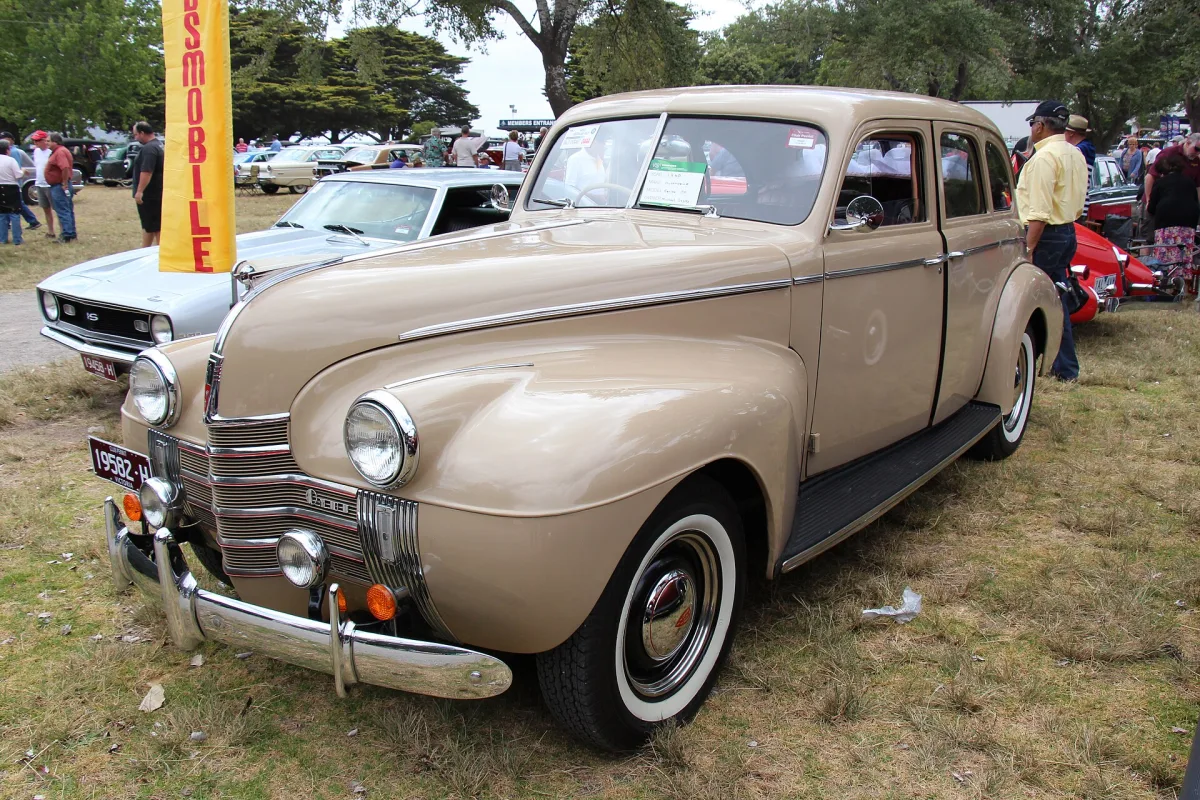
The real thing arrived in October 1939: the Hydra-Matic, a $57 option on the 1940 Oldsmobile. Fluid coupling, four speeds, no clutch pedal at all. GM launched it on Oldsmobile rather than Cadillac on purpose, to protect Cadillac's reputation in case the thing flopped.
It didn't flop. About 60,000 buyers took the option in the first year. For 1941 GM nearly doubled the price to $100, and sales doubled anyway.
The first mass-produced automatic had no Park position. The selector read N, Hi, Lo, R. To park, the manual told you to shut off the engine and leave the transmission in Reverse.
Tanks first, suburbs later
Then the war came, and the automatic transmission went with it. The M5 Stuart light tank carried two Cadillac V8 engines, each bolted to its own Hydra-Matic. Around 25,000 Allied military vehicles used the transmission. After 1945, Oldsmobile ads sold it as "battle-tested," which for once was plain truth.
The war work paid a second dividend. GM's torque-converter drives from the M18 Hellcat and M26 Pershing tanks became the 1948 Buick Dynaflow, the first torque-converter automatic in a mass-produced car. In Drive it never shifted at all; one gear, with the converter doing all the work. Gloriously smooth, famously slow. Detroit wags called it the Dynaslush.
The Hydra-Matic itself became an export hit. Lincoln, Nash, Hudson and Kaiser bought it, and from 1952 Rolls-Royce built it under license for cars that cost ten Oldsmobiles.
America shifts over
In January 1950, Chevrolet's Powerglide brought the automatic to cheap cars: $159 on a car anyone could afford. Ford followed in 1951, Chrysler, last of the Big Three, in late 1953. By 1957 about 80 percent of new American cars shifted themselves. The question in a US showroom stopped being whether you wanted an automatic and became which one.
Detroit even got playful. From 1956 to 1964, every automatic Chrysler shifted by push-buttons on the dashboard. The engineers never solved a push-button parking pawl, so there was no Park button; you pulled a separate lever for that.
Europe says no thanks
Europe watched all this and kept its manuals for another half century. The reasons were practical. Fuel cost a multiple of the US price, and for decades manuals used less of it. European cars were smaller and cheaper, so an automatic added a painful surcharge. And the license rules had teeth: in the UK and Germany, pass your driving test on an automatic and you were legally barred from driving a manual. Germany only softened that rule in April 2021.
Which is not to say Europe didn't build automatics. The first German one came not from Mercedes but from Borgward in Bremen, which put its in-house automatic into the Hansa 2400 in 1952. The gearbox was so troublesome it became one of the nails in Borgward's coffin. Mercedes followed in 1961 with its own four-speed unit, and that one stuck.
The most original European answer came from the Netherlands. The 1958 DAF 600 used the Variomatic, a continuously variable transmission driven by rubber belts: no gears at all, just two cone pulleys sliding in and out. Every modern CVT descends from that idea.
A Variomatic has no separate reverse gearing, so a classic DAF can drive as fast backwards as forwards. The Dutch turned this into an actual spectator sport: reverse racing.
The gear race
The oil crisis of the 1970s forced the automatic to grow up. Chrysler brought back the lock-up torque converter in 1978 to stop wasting fuel at cruise. In the early 1980s the microprocessor took over the shifting logic; Toyota claims the world's first computer-controlled automatic, with BMW and ZF close behind in 1983.
Racing added the next idea. Porsche's dual-clutch PDK won its first race at Monza in 1986, with Hans-Joachim Stuck delighted that he never had to take his hands off the wheel. For the Le Mans 24 Hours that same year, Porsche didn't trust it and fitted the winning car with an old 5-speed manual. The dual-clutch needed until 2003 to reach a production car, the VW Golf R32 with the first DSG.
Then the gear counting started. Mercedes shipped the first 7-speed in 2003, Lexus the first 8-speed in 2006, ZF presented its 8HP in 2008 with a plain sales pitch: about 12 percent less fuel than the old 6-speed. A 9-speed followed in 2013. Ford and GM, rivals in everything, jointly developed a 10-speed and put it into the F-150 and the Camaro ZL1. Around 2012, US fleet data showed automatics passing manuals in fuel economy, and the manual lost its last practical argument.
The gearbox disappears
Today over 99 percent of new cars in the US have automatics. Even Europe has flipped: manuals fell to 29 percent of new-car sales in Europe's five biggest markets in 2024, and two thirds of new German cars are automatics. In a 2020 YouGov poll, 46 percent of Germans still said they prefer a manual. They praise the stick, then buy the automatic.
The ending has a twist, though. Electric cars don't shift. An electric motor pulls from zero rpm, so almost every EV uses a single fixed gear; the Porsche Taycan, with its two-speed rear axle, is one of the few exceptions. There is nothing left to automate.
It took four decades to teach the car to shift for itself, and another eight to perfect it. Now the automatic transmission is not losing to a better gearbox. It is winning so completely that the gearbox itself is going away.
If you want the long version of how these machines shaped a century, Paul Ingrassia's Engines of Change * (affiliate link) tells it through fifteen American cars.
The timeline
-
1904
The Sturtevant brothers of Boston build the first car with an automatic transmission. It tends to self-destruct.
-
1923
Alfred Horner Munro patents an automatic transmission running on compressed air. Too weak, never produced.
-
1933
REO's Self-Shifter semi-automatic: "No Gears to Shift." Works fine, sells poorly.
-
1939
GM launches the Hydra-Matic, the first mass-produced fully automatic transmission, as a $57 option on the 1940 Oldsmobile.
-
1948
Buick Dynaflow: the first torque-converter automatic in a mass-produced car.
-
1952
Borgward builds the first German automatic, nine years before Mercedes.
-
1957
About 80 percent of new American cars now shift themselves.
-
1958
The DAF 600 introduces the Variomatic, ancestor of every modern CVT.
-
1978
The lock-up torque converter returns after the oil crisis; electronics follow in the early 1980s.
-
1986
Porsche's dual-clutch PDK wins its first race at Monza.
-
2003
VW Golf R32 brings the first mass-production dual-clutch DSG; Mercedes ships the first 7-speed.
-
2006
Lexus LS 460: the first 8-speed. ZF's 8HP follows in 2008, a 9-speed in 2013, a Ford/GM 10-speed in 2016.
-
~2012
US fleet data shows automatics overtaking manuals in fuel economy.
-
2019
Porsche Taycan launches with a two-speed gearbox, a rare exception among single-speed EVs.
-
Today
Over 99 percent of new US cars are automatics. Most EVs don't shift at all.
Sources
- Ate Up With Motor: Hydra-Matic History
- Mac's Motor City Garage: Inside the 1940 GM Hydra-Matic
- Mac's Motor City Garage: The 1933–35 REO Self-Shifter
- Google Patents: Alfred Horner Munro, US 1,613,525
- PistonHeads: Origins of the Automatic Transmission
- Wikipedia: Hydramatic
- Wikipedia: DAF 600
- Borgward: Pioneering Innovations (Hansa 2400)
- Porsche Newsroom: Rainer Wüst and the PDK
- US Department of Energy: Transmission Trends
- The Autopian: When Automatics Beat Manuals on Fuel Economy
- Auto Zeitung: Handschaltung oder Automatik (DAT/YouGov figures)
- Porsche Newsroom: Taycan Powertrain
*Affiliate link. As an Amazon Associate I earn from qualifying purchases.