
Dubai dredged sand from the seabed, shaped it into a palm, and sold the postcard before the first villa had a roof. Copenhagen is also building new land in the sea right now, a whole city district called Lynetteholm, and it is tempting to call it the Dubai of Denmark. The comparison even holds. Just backwards, in almost every detail, starting with the building material.
The newest piece of Denmark is made of leftovers.
A peninsula from the reject pile
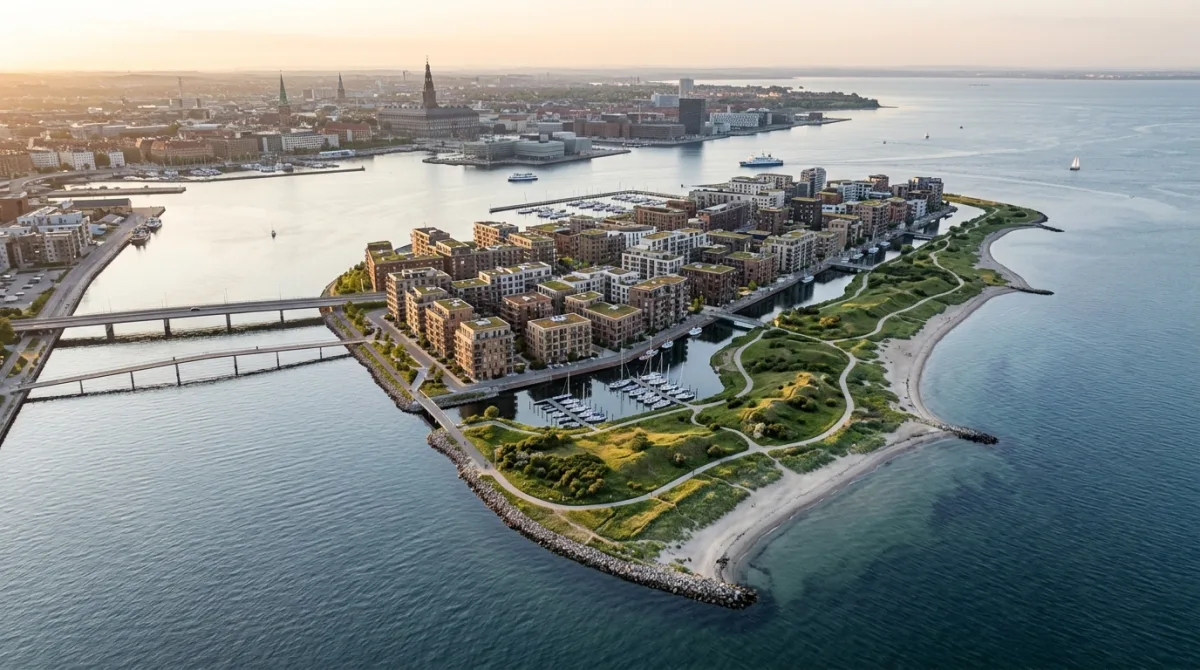
Lynetteholm is an artificial peninsula of about 2.8 square kilometers, rising in Copenhagen's harbor between Nordhavn and Refshaleøen. The Danish parliament approved it on June 4, 2021, and By & Havn, the public company that develops the city's port areas, has been building it since January 2022.
The fill is not sand from the seabed. It is surplus soil from construction sites: the earth that comes out of the ground whenever someone in the Copenhagen region digs a foundation pit, a metro shaft or a parking garage. Around 80 million tons of it will be tipped into the sea over roughly three decades. Builders used to truck this material to deposits far outside the city. Now they pay a fee to unload it at Lynetteholm instead.
That fee is the financial trick behind the whole project. The dumping charges and, later, the sale of building plots are meant to cover the costs, so the new district pays for itself as it grows. A landfill that slowly turns into waterfront real estate, with the disposal customers footing the bill.
Copenhagen has played this game for 400 years. In the 1620s, King Christian IV had embankments built in the shallow water between Copenhagen and Amager, and the district of Christianshavn still stands on those artificial islands today. Lynetteholm is the old trick at modern scale.
The dam came before the island
Before any soil could go in, the peninsula needed an edge. Since January 2022, a stone dam has been built up from the seabed, seven kilometers of rock in total, part of it shipped in from Norway. This perimeter does two jobs at once: it holds the fill in place, and it is a storm surge barrier for the low-lying capital. Officially, Lynetteholm is section 11 of 14 in Copenhagen's coastal protection plan.
The seaward east coast is the clever part. Instead of a vertical wall, the plans show some 60 hectares of soft coastal terrain: beaches, dunes and coastal forest, shaped to swallow the energy of incoming waves. A jagged, gently sloping shore is also easier to raise later if the sea climbs faster than forecast. This green edge is scheduled to open to the public in 2029, decades before the district behind it exists.
A king in an excavator
On June 17, 2026, the perimeter was finished, and Denmark marked the moment in a very Danish way. King Frederik X put on a hard hat, was received at an excavator by machine operator Poul Holmgaard of the contractor Aarsleff, and tipped the final bucket of stone and gravel onto the dam himself. With that load, the seven-kilometer ring around Lynetteholm closed.
Since August 23, 2026, Copenhageners can walk the full loop around their future district, about 4.7 kilometers of path on the new dam. It may be the strangest city walk in Europe: a full circle around a neighborhood that is mostly still water, decades away from its first residents.
The walk exists roughly 44 years before the district does. Lynetteholm is not expected to be fully built out until around 2070, so most of the people who will live inside the ring have not been born yet.
The Baltic is the counterargument
Not everyone claps. The Baltic Sea is brackish, and its ecosystem depends on pulses of salty, oxygen-rich water flowing in from the Kattegat through a handful of deep channels. One of those channels, Kongedybet, runs right past Copenhagen, and the new peninsula sits in its way. Critics, among them Danish and Swedish researchers and environmental groups, argue that the project's environmental assessment treated this salt flow too lightly. In 2022, seventeen organizations complained to the EU Commission.
The Danish climate movement Klimabevægelsen went further and sued the Ministry of Transport and By & Havn in 2021. In March 2024, the Eastern High Court decided the case may run its course but construction does not have to pause. The diggers kept digging. There is also the carbon math: according to the project's own environmental filings, cited by TIME, building Lynetteholm will emit around 243,000 tons of CO2 between 2023 and 2055, which opponents find hard to square with a project sold as climate protection.
And then there is the accusation in the nickname itself: that behind the storm surge story, Copenhagen is really building premium waterfront property. The city answers with its planning rules, which require a share of affordable housing in new districts. Who is right will only be visible around 2070, which is a comfortable deadline for everyone currently making promises.
Dubai, but in reverse
Hold the two projects side by side and the nickname flips. Palm Jumeirah was a luxury vision first, conjured from clean dredged sand, marketed with renderings of villas and hotels years before completion. Lynetteholm started as flood protection and a waste problem, is built from the unglamorous contents of foundation pits, and will not welcome its first residents for years. The approved plan reckoned with 35,000 people living there. Reporting around the 2026 milestone puts the current ambition at up to 50,000 residents and 30,000 jobs, connected by a new metro line and an eastern ring road tunnel that both, as of today, are still not finally approved.
One more difference, and it is the punchline: megaprojects are famous for blowing their budgets. The Danish economist Bent Flyvbjerg has spent a career documenting this and turned it into the book How Big Things Get Done * (affiliate link), where nine out of ten big projects run over budget, over time, or both. His home country's biggest land-building project, of all things, reported itself on schedule and on budget when the king closed the ring.
So the Dubai of Denmark has no palm shape, no marketing villas and no dredged sand. It has a stone ring in a cold sea, a court case, a public footpath around an empty future, and a business model that turns yesterday's basements into tomorrow's coastline, truckload by truckload. The postcard will take until 2070. The walk is open now.
The timeline
-
1620s
Christian IV builds embankments between Copenhagen and Amager. Christianshavn still stands on that reclaimed ground.
-
2021
June 4: the Danish parliament approves Lynetteholm. Klimabevægelsen sues the Ministry of Transport and By & Havn the same year.
-
2022
January: construction of the perimeter dam begins. Seventeen organizations complain to the EU Commission.
-
2023
The first loads of surplus soil from Copenhagen construction sites go into the sea.
-
2024
March: the Eastern High Court lets the lawsuit continue but allows construction to carry on in the meantime.
-
2026
June 17: King Frederik X tips the final bucket of stone from an excavator and closes the seven-kilometer ring. August 23: the 4.7-kilometer walk around Lynetteholm opens.
-
2029
The green east coast with beaches, dunes and coastal forest is scheduled to open to the public.
-
~2050s
After roughly three decades of soil deliveries, the landfilling is expected to be complete.
-
~2070
The district is expected to be fully built out, with tens of thousands of residents.
Sources
- By & Havn: Lynetteholm (official project site)
- TIME: How an Artificial Island Became One of Europe's Most Controversial Climate Projects
- The Danish Royal House: H.M. the King inaugurates Lynetteholm's perimeter
- DR: The king put on the helmet and closed the ring around Lynetteholm
- Dansk Byudvikling: A major milestone for Lynetteholm
- State of Green: Lynetteholm, climate and flood protection
- CNN: Inside plans for Copenhagen's divisive artificial peninsula
- Euronews: Artificial island given the green light despite environmental concerns
- Dezeen: Artificial island Lynetteholm to be built in Copenhagen harbour
- Wikipedia: Christianshavn
*Affiliate link. As an Amazon Associate I earn from qualifying purchases.