
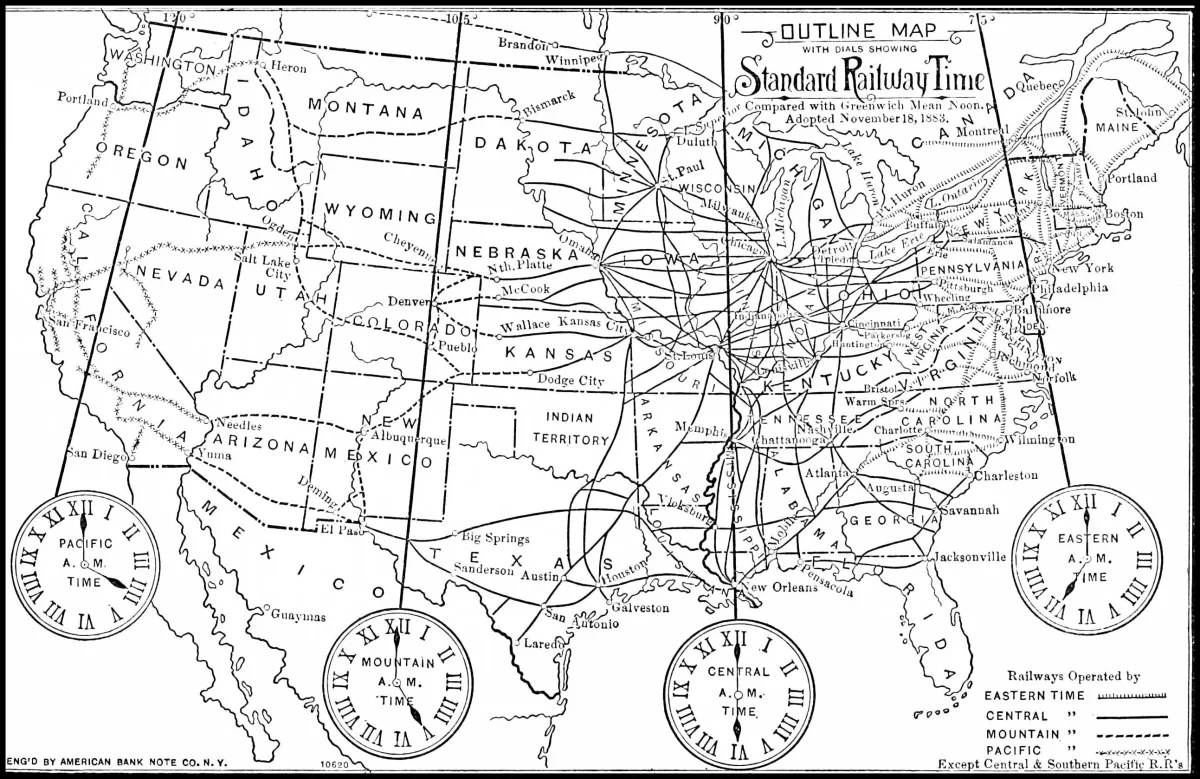
On November 18, 1883, a telegraph signal went out from the Allegheny Observatory in Pittsburgh at noon on the 90th meridian. Railroads across the United States and Canada reset their clocks to it at the same moment. In towns whose old local time ran behind the new standard, the clocks were turned back and noon happened twice.
People called it the Day of Two Noons. It is the day the modern time zone was born, and the reason it happened at all was the train.
Everybody kept their own noon
Before that, time was a local matter. Noon was when the sun stood highest over your town, which meant your noon and the next town's noon were minutes apart. The United States had more than 300 local sun times to choose from.
None of that mattered while the fastest thing on the road was a horse. A traveler simply reset a pocket watch on arrival. Railroads broke the arrangement: a timetable that spans a thousand miles cannot be written in 300 different times, and two trains running on two different noons can end up on the same track.
Britain got there first, with a second minute hand
The problem showed up in Britain decades earlier, because the railways did. The Great Western Railway synchronized its stations in November 1840, the first recorded case of separate local times being pulled onto one standard, and other lines followed through the 1840s.
Towns did not simply give in. London time ran about ten minutes ahead of Bristol and Exeter, so some clocks were fitted with two minute hands, one for local time and one for railway time, turning the dial into a small diplomatic compromise. Christ Church in Oxford ran its Tom Tower clock the same way. The Dean of Exeter Cathedral held out until November 1852.
Britain did not make one national time legally binding until the Statutes (Definition of Time) Act received royal assent on August 2, 1880, forty years after the first railway tried it.
For years some English station clocks carried two minute hands on one face: one showing the town's own sun time, the other showing railway time. Passengers had to know which hand their train ran on.
One telegraph signal
In America the idea had been circling for years. The schoolteacher Charles F. Dowd proposed four national zones in 1870 and reworked the plan around the Greenwich meridian in 1872. Cleveland Abbe, who ran the weather service, wanted standard zones so his observers could compare readings, and recommended four of them in 1879. That same year, on February 8, the Canadian engineer Sandford Fleming put a worldwide scheme to the Royal Canadian Institute.
What finally moved was the industry itself. Railroad managers met in Chicago on October 11, 1883 and adopted a five-zone plan drawn up by William F. Allen. Six weeks later the telegraph signal went out, and a country of 300 local times became a country of five.
The rest of the world, eventually
In October 1884, twenty-six countries sent 41 delegates to Washington for the International Meridian Conference. They voted to make the meridian through the Greenwich transit instrument the world's zero for longitude: 22 in favor, one against, two abstentions. The lone no vote came from San Domingo. The two abstentions were Brazil and France.
Adoption then took decades. The German Empire only unified on Central European Time on April 1, 1893, ten years after the American railroads had settled the matter for a continent.
The leftovers
The map never became tidy, because time zones follow politics rather than the sun.
Nepal sits at UTC+5:45, fifteen minutes off its large neighbor India, and is one of only three time zones in the world with a 45-minute offset. China spans five geographical time zones and officially runs on one, so an evening in Kashgar arrives on Beijing's clock; in Xinjiang, a second unofficial time runs alongside it two hours behind.
And the country with the most time zones on Earth is not Russia or the United States. It is France, which reaches 12 through its overseas departments and territories, or 13 if you count its claim in Antarctica. The nation that abstained from the Greenwich vote in 1884 ended up spread across more of the clock than anyone else.
The timeline
-
1840
The Great Western Railway synchronizes its stations, the first recorded standard time.
-
1852
The Dean of Exeter Cathedral finally gives up local time. Some clocks had been running two minute hands.
-
1870
Charles F. Dowd proposes four time zones for the United States.
-
1879
Sandford Fleming presents a worldwide scheme; Cleveland Abbe pushes four US zones for weather reporting.
-
1880
Britain gives one national time legal force, forty years after its railways adopted it.
-
1883
November 18: the Day of Two Noons. North American railroads switch to five zones on a single telegraph signal.
-
1884
The International Meridian Conference picks Greenwich. France and Brazil abstain.
-
1893
The German Empire unifies on Central European Time.
-
Today
France has 12 time zones, more than any other country. China has one, across five geographical zones.