In Roar Uthaug's Troll, the Netflix film that arrived on December 1, 2022, the monster dies the way every Norwegian schoolchild expects it to. Sunlight hits it and it stops being alive. The sequel that followed on December 1, 2025 keeps the rule intact.
The rule is old. It is also, in the oldest written sources we have, not about trolls at all.
The word came first
Old Norse had the noun troll (also written trǫll), but it did not describe one kind of creature. The Cleasby-Vigfusson dictionary, still the standard reference for the language, glosses it as a generic term for "a giant, fiend, demon." Norse heathens had no Devil, so troll did that job instead: it covered anything huge, supernatural and usually hostile. Werewolves counted. So did people who could change shape, described as eigi einhamr, not of a single skin.
You can see the range in the fixed phrases. Troll hafi þik means "may a troll take you," a curse. Troll milli húss ok heima, a troll between the house and home, works like the English "between the devil and the deep blue sea." And then there is tryggr sem tröll, faithful as a troll, because in some stories the old giants repay a kindness and keep their word. The word was closer to "monster" than to any species, and the species came later.
A troll answers the question
The oldest surviving attempt to say what a troll actually is comes from the troll's own mouth.
Snorri Sturluson's Prose Edda, written in Iceland around 1220, contains a book on poetic craft called Skáldskaparmál. In it, a poet rides through a forest late one evening and a troll-woman stops him and demands to know who is passing. She introduces herself first, in a chain of kennings, the compressed riddle-metaphors that skaldic poetry ran on. Arthur Gilchrist Brodeur's 1916 translation:
They call me Troll; Gnawer of the Moon, Giant of the Gale-blasts, Curse of the rain-hall, Companion of the Sibyl, Nightroaming hag, Swallower of the loaf of heaven. What is a Troll but that?
The Old Norse begins Troll kalla mik, and scholars still disagree about the first three words. Anthony Faulkes, whose 1995 edition is the standard modern English text, reads it as "Trolls call me," making the list her name among her own kind. The Skaldic Poetry of the Scandinavian Middle Ages database prefers "They call me troll," making it a definition offered to a human. Both readings are defensible and the choice changes who the answer is for.
Snorri credits the verse to Bragi Boddason, the earliest named skald whose poetry survives, active in the first half of the 9th century. The encounter itself is generally treated as a legend rather than biography, so the verse may well be younger than Bragi. What survives either way is the shape of the answer. Asked what she is, the troll replies with six riddles and a shrug, and the poet answers her with kennings of his own about what a poet is. Nobody in the scene finds this odd.
"Swallower of the loaf of heaven" reads literally as "wheel-swallower of the sky," a kenning for the sun and so for the thing that eats it. Norse myth has that appetite elsewhere too: two wolves chase the sun and the moon across the sky and catch them at Ragnarök.
The sunlight rule belongs to a dwarf
Turning to stone at sunrise is the one thing everybody knows about trolls, and the two clearest early examples are not trolls.
The first is Alvíssmál, a poem in the Poetic Edda. Alvíss is a dwarf, named as one throughout, and he has come to claim Thor's daughter. Thor keeps him talking, question after question about the names of things, until the sun comes up and the dwarf is stone. The trap is the conversation.
The second sits inside Helgakviða Hjörvarðssonar. Hrímgerðr, called a gýgr or giantess, is kept in a flyting, an exchange of insults in verse, until dawn arrives. The stanza that ends her is blunt about the method: Dagr er nú, Hrímgerðr, en þik dvalða hefr Atli til aldrlaga. Day is here now, Hrímgerðr, and Atli has delayed you to your death. She stands in the harbor afterwards as a landmark, in the shape of a stone.
A dwarf and a giantess, then, and in both cases someone talks them into the sunrise on purpose. The poems are preserved in a 13th-century manuscript, the Codex Regius, though the verse in it is older and how much older has been argued over for two centuries. What the sources show is a motif that applies broadly to beings of the dark, which only later narrowed onto the troll and became its signature weakness.
The giants shrank
Somewhere between the sagas and the 19th century, the troll lost most of its height.
Scandinavian folk tradition records small trolls living in burial mounds and inside mountains, troldfolk and bjergtrolde in Denmark, trollfolk and tusser in Norway, described as human-sized or much smaller depending on the district. The scholar John Lindow, whose Trolls: An Unnatural History * (affiliate link) traces the whole arc, places the familiar ugly monster of modern fantasy no earlier than the later Middle Ages, and points out that early trolls were as often helpers as troublemakers.
The version we picture was fixed in print, and the printing was Norwegian. Peter Christen Asbjørnsen and Jørgen Moe published a thin, untitled pamphlet of folk tales in 1841, with no editors' names and no table of contents. Proper volumes followed in 1843 and 1844, a second edition in 1852, a fifth by 1874. The original collection ran to 58 tales, later 60, and a second collection of 50 more appeared in 1871. Among them is De tre bukkene Bruse, three billy goats and a troll under a bridge, which is now the first troll most English-speaking children ever meet.
Two illustrators finished the job
The tales were text only at first. The 1879 edition was the first fully illustrated one, with work from Peter Nicolai Arbo, Hans Gude, Erik Werenskiold and others, and it is where the troll acquired a face.
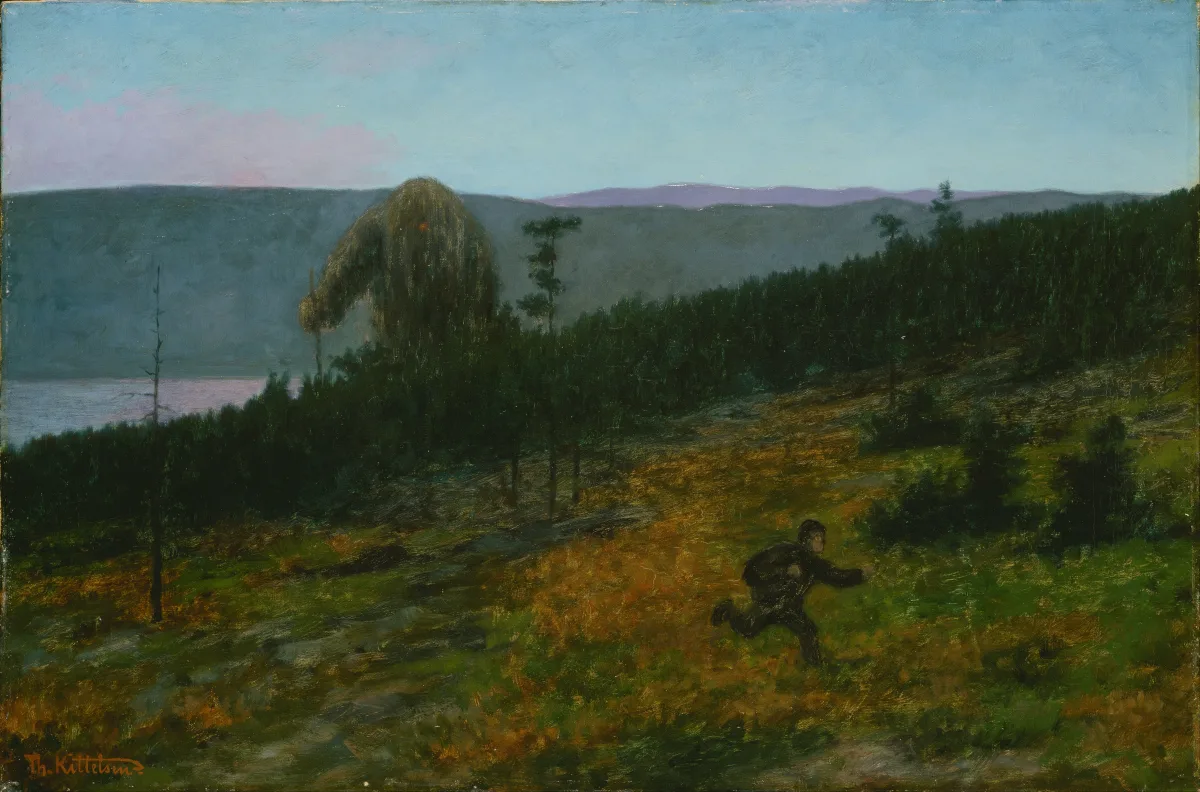
Theodor Kittelsen (1857 to 1914) drew the definitive ones. Skogtroll, the forest troll, dates from 1906; Juletroll from 1907; Trollet som grunner på hvor gammelt det er, the troll wondering how old it is, from 1911. His trolls have moss on their backs, trees growing out of their heads, and one enormous nose, and they are usually more melancholy than frightening. In Sweden, John Bauer (1882 to 1918) illustrated the anthology Bland tomtar och troll every year from 1907 to 1915 and produced the other half of the image, including Still, Tuvstarr sits and gazes down into the water in 1913.
Between them, two men working within a decade of each other decided what a troll looks like, and every troll since has been drawing from their sketchbooks.
Norway keeps the evidence outdoors
The sunlight rule left physical proof, which is the part of this that stays surprising. Along the Helgeland coast, the mountains are the cast of a single story.
Hestmannen chased the beautiful Lekamøya south down the coast. Her seven sisters joined the flight and found the chase entertaining enough that they lost track of the hour. When he saw he could not catch her, Hestmannen shot an arrow. The king of Sømna threw his hat into its path and the arrow punched through the felt and lost its force. At that moment the sun came up and the whole scene turned to stone.
The seven sisters are the peaks of De syv søstre, standing in a row between Sandnessjøen and Alstahaug. The hat is Torghatten, a 258-meter mountain outside Brønnøysund with a hole punched clean through it: 166 meters long, an average of 41 meters high, sitting 115 meters above the sea. You can walk it. Hestmannen is still lying off the coast near the Arctic Circle, and Lekamøya made it as far as the island of Leka. Every one of these is a real place with a ferry timetable.
Trolltunga, the rock ledge whose name means "the troll's tongue," has no old legend attached to it at all. Fewer than 800 people hiked to it per year until 2010. By 2016 it was around 80,000. The photograph did what the folklore never had to.
The internet troll swam in from somewhere else
Here the family tree splits, and the split runs the opposite way from what almost everyone assumes.
The English verb troll arrived in the late 14th century from Old French troller, to wander about in search of game. By around 1600 it had picked up its fishing sense, to draw a baited line slowly through likely water and wait for something to strike. The creature is a separate import: the noun entered English from Old Norse only in the 1610s, roughly two centuries later.
The internet sense grew out of the fishing verb. On Usenet, veterans of the newsgroup alt.folklore.urban went "trolling for newbies," posting questions so thoroughly settled that only a newcomer would answer them in earnest. It was an in-joke before it was an insult. The Oxford English Dictionary's earliest citation for the online meaning is dated December 14, 1992, from that same newsgroup. A post from 1993 shows the grammar already shifting: "Or have I just been trolled?" The bait had started acting on the person instead of the water.
The monster then walked back into the picture sideways. Once the noun was in use, the folk etymology took over, and the internet troll became a creature living under a bridge rather than a technique borrowed from fishing. That is the wrong origin, and it has won so completely that the right one now sounds like a correction.
Back to the forest
Uthaug's film is the fourth or fifth act of this, depending on where you start counting. It puts the troll back at full size, walks it out of the Dovre mountains, and kills it with the sunrise the way the Edda kills a dwarf. The production was called the largest in Nordic film history, shot in 2024 across Trondheim, Jotunheimen, Rjukan and Budapest for the second installment.
Eight hundred years earlier, in a manual on how to write poetry, someone met one on a forest road and asked what she was. She gave him six kennings and left the question standing. What is a troll but that?
The timeline
-
9th c.
Bragi Boddason, the earliest named skald whose verse survives, is later credited with the troll-woman exchange.
-
c. 1220
Snorri Sturluson writes the Prose Edda in Iceland. Skáldskaparmál preserves the troll's self-description.
-
13th c.
The Codex Regius manuscript preserves the Poetic Edda, including the dwarf Alvíss and the giantess Hrímgerðr turning to stone at dawn.
-
1610s
The noun "troll" enters English from Old Norse, meaning a giant or evil spirit.
-
1841
Asbjørnsen and Moe publish their first pamphlet of Norwegian folk tales, with no title page and no editors' names.
-
1879
The first fully illustrated edition of the tales gives the troll a face.
-
1906
Theodor Kittelsen paints Skogtroll. John Bauer illustrates Bland tomtar och troll from 1907 to 1915.
-
1992
December 14: the OED's earliest citation of "troll" in the internet sense, from the newsgroup alt.folklore.urban.
-
2016
Around 80,000 people hike to Trolltunga, up from fewer than 800 a year before 2010.
-
2022
Netflix releases Troll on December 1. The sequel follows on December 1, 2025.
Sources
- Wikipedia: Troll (with Faulkes 1995 translation of the Bragi verse)
- Skaldic Poetry of the Scandinavian Middle Ages: Snorri Sturluson, Skáldskaparmál 67
- Brodeur's 1916 translation of the Prose Edda
- Cleasby-Vigfusson Old Norse Dictionary: tröll
- Wikipedia: Alvíssmál
- Heimskringla: Helgakviða Hjörvarðssonar (Old Norse text)
- Wikipedia: Norske Folkeeventyr, Asbjørnsen and Moe
- John Lindow, Trolls: An Unnatural History
- Wikipedia: Theodor Kittelsen
- Wikipedia: John Bauer
- Visit Helgeland: Trolls and myths of Helgeland
- Wikipedia: Torghatten
- Wikipedia: Trolltunga
- Online Etymology Dictionary: troll
- Ben Zimmer: You've Been Trolled!
- Wikipedia: Troll (2022 film)
*Affiliate link. As an Amazon Associate I earn from qualifying purchases.