
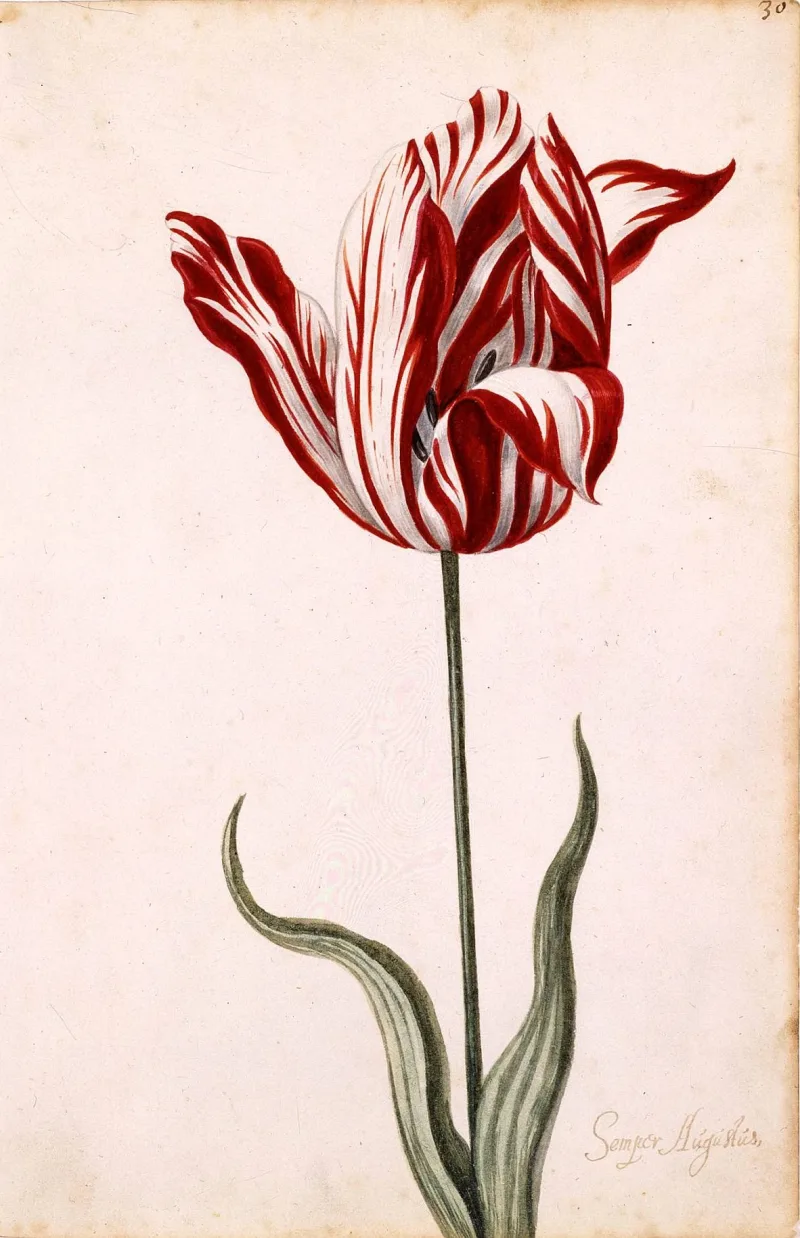
The most famous flower in economic history has red flames licking up white petals, a stem that bends a little under the bloom, and a name like a Roman emperor: Semper Augustus. In the 1620s a single bulb was said to be worth 1,000 guilders, at a time when a master craftsman earned about 300 a year. By 1637 people were quoting ten times that. And the plant everyone wanted was, in the plain botanical sense, ill.
The flames were a symptom. The price was a rumor. And the crash that ended the Dutch tulip mania in February 1637, the one that supposedly dragged a whole nation into ruin, cannot be shown to have bankrupted a single person. The story has been told for nearly four hundred years, and most of it is wrong in interesting ways.
The legend
As usually told, the entire Dutch Republic lost its mind over tulips in the mid-1630s. Nobles, farmers, sailors, maidservants and chimney sweeps all speculated in bulbs. One Viceroy bulb changed hands for a pile of goods that included four oxen, eight pigs, twelve sheep, a thousand pounds of cheese, a bed and a silver cup. A sailor mistook a Semper Augustus for an onion, ate it with his herring and went to prison. Then, in February 1637, prices collapsed overnight, fortunes evaporated, and the Dutch economy needed years to recover.
Nearly every sentence of that comes from one source: Charles Mackay's Extraordinary Popular Delusions and the Madness of Crowds, published in 1841, two centuries after the events. Mackay gave tulips about seven pages. The financier Bernard Baruch had the book reissued in 1932, after the Wall Street crash, and it has been the standard parable for every bubble since, from dot-com stocks to crypto. Mackay gave neither dates nor sources for his prices. He did no research of his own either; his anecdotes came, by way of a German professor, from pamphlets and travelogues written long after 1637.
That deserves a closer look. But first the flower.
A flower from the Ottoman court
Tulips are not Dutch. They are wild flowers of Central Asia, and the Ottoman court grew them long before anyone in Europe saw one. Ogier de Busbecq, the Habsburg ambassador to Suleiman the Magnificent, sent bulbs and seeds from Constantinople to Vienna in 1554. The name comes from the Turkish word for turban, probably because of the shape, possibly through a misunderstanding.
The botanist Carolus Clusius carried the flower north. He took up a post at Leiden University in October 1593, laid out its botanical garden, and in spring 1594 the first tulips flowered on Dutch soil. Clusius treated his bulbs as a scientific collection and refused to sell. It did not help him. His garden was broken into twice in the summer of 1596 and again in spring 1598, and in one raid more than a hundred bulbs vanished. Clusius, then in his seventies, swore he would give up gardening.
The Dutch tulip trade began with a burglary. The historian Mike Dash argues that the bulbs stolen from Clusius's Leiden garden in the 1590s were the ancestors of the flowers speculated on forty years later. A national industry started from stolen stock.
The disease that sold
What made a tulip valuable in 1636 was pattern, not color. A plain red or yellow tulip was cheap. The prized flowers were "broken": petals with a white or yellow base, feathered and flamed in red, purple or brown, every bloom slightly different. Growers could not breed the effect on purpose. A plain tulip would one spring, for no visible reason, come up broken, and from then on its offsets carried the pattern. Nobody knew why. Some blamed the soil, some the weather, some a kind of ennoblement of the plant.
The answer came in 1928. Dorothy Cayley, a mycologist at the John Innes Horticultural Institution in England, grafted tissue from broken bulbs into healthy ones and showed that the breaking passed from plant to plant. It was an infection. The tulip breaking virus, a potyvirus that aphids carry from plant to plant, disrupts the distribution of pigment in the petals. The flames are where the color failed.
The virus also explains the prices. An infected bulb is a weakened bulb. It produces fewer offsets each year, each generation grows a little smaller, and eventually the plant stops flowering altogether. Broken varieties were rare because they were sick, and expensive because they were rare. The Semper Augustus never existed in more than a handful of bulbs; in 1624 a chronicler counted twelve, all in the hands of one owner. The variety is extinct. By 1739 a Haarlem catalog offered something called Semper Augustus for a tenth of a guilder, which suggests the name had by then been pinned on a common flower.
Today, broken tulips are a pest problem, not a treasure. Commercial growers pull and destroy them, and several countries prohibit the sale of infected bulbs. The striped "Rembrandt" tulips in garden centers are stable bred varieties with no virus in them. One authentic survivor of the mania era still flowers: the Zomerschoon, first recorded in 1620, kept at the Hortus Bulborum in Limmen, a living museum with more than 4,500 historic varieties.
Two months in a tavern
The speculative phase was short. Prices began climbing in November 1636 and collapsed in the first week of February 1637. The trade did not run through an exchange but through "colleges", groups of florists meeting in the back rooms of inns. In Haarlem, the center of it all, the college met at the Golden Grape on the market square; other taverns in the trade were called the Finch, the Lion and the Devil on a Chain. Deals were struck on slates with chalk, and every concluded sale carried "wine money", half a stuiver per guilder up to a maximum of three guilders, spent on the spot.
Bulbs cannot be lifted while they grow, so between autumn and June nobody could deliver anything. What changed hands were promissory notes for bulbs still in the ground, priced by weight in aces, a unit so small that a Haarlem pound held nearly ten thousand of them. A buyer might resell his note the same evening. Contemporaries called it windhandel, the wind trade, because nothing but air was moving. The colleges never checked whether their members could pay their debts, or even owned the bulbs they sold.
All of it happened against a grim background. Plague killed more than 5,700 people in Haarlem between August and November 1636. Some historians see a connection: death made money feel cheap. Anne Goldgar, who has done the most thorough archival work on the mania, is skeptical, because the steepest price jumps came in January 1637, when plague, mainly a summer disease, was fading.
Alkmaar, February 1637
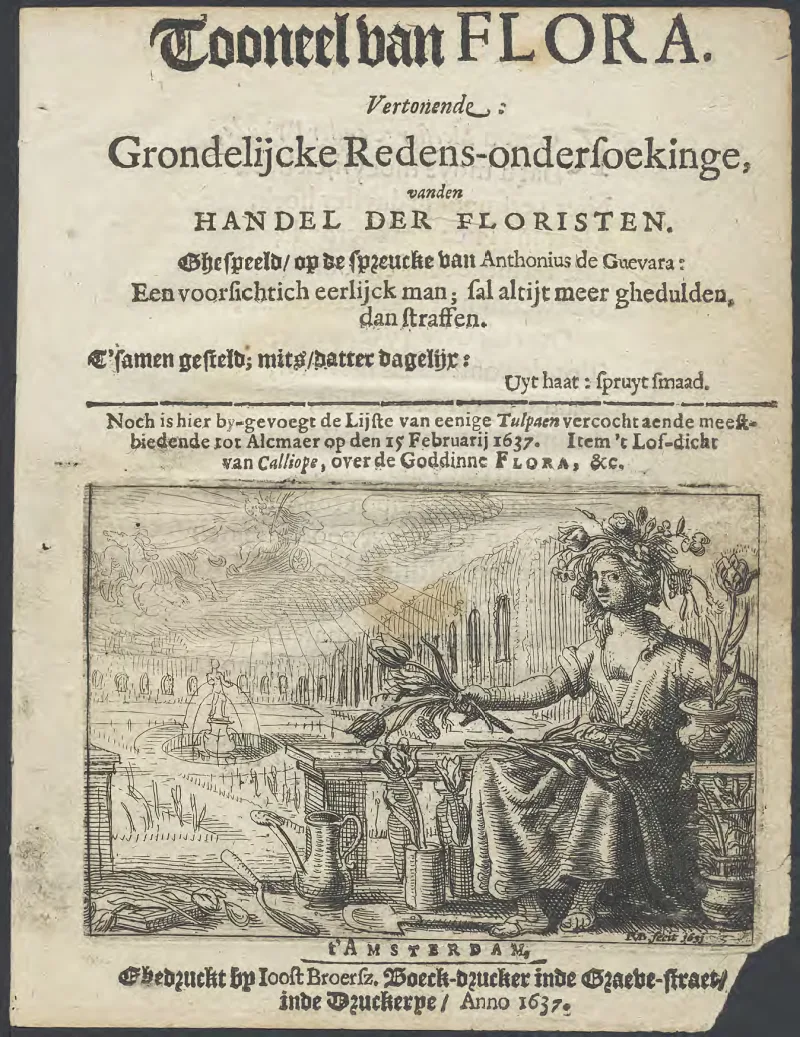
The one set of big prices with a solid paper trail comes from a sale in Alkmaar in the first days of February 1637. Wouter Winkel, an innkeeper, had died the year before and left seven children in the orphanage, along with roughly seventy tulip bulbs of forty varieties. The orphanage board auctioned the collection in 99 lots for the children's benefit. The total came to about 90,000 guilders. An Admirael van Enkhuizen fetched 5,200 guilders, two Viceroys 4,203 and 3,000. A printed list of the results was circulating within weeks.
Set that against wages. Three hundred guilders was roughly a master craftsman's income for a year. A day laborer made about one guilder a day. Five thousand guilders, Goldgar notes, was the going rate for a nice house.
The famous Semper Augustus prices, by contrast, are hearsay. They go back to Nicolaes van Wassenaer, a chronicler writing in the 1620s: a bulb worth 1,000 guilders in 1624, an owner refusing 1,200, then 2,000 and 3,000 offered the following year. The 5,500 guilders of 1633 and the 10,000 guilders for 1637 that appear in every retelling have no documented sale behind them at all.
The best-documented prices of the tulip mania were paid for a dead man's flowers. The record sale in Alkmaar was an estate auction for an innkeeper's orphaned children, held days after a sale in Haarlem had already failed to find a single buyer.
The crash that ruined nobody
On February 3, 1637, a bulb auction in Haarlem attracted no bids. Within days nobody wanted to be the last holder of a promissory note. Prices did not so much fall as stop existing, because nobody bought. That much the legend gets right.
What followed was paperwork. On February 24, delegates of the florists meeting in Amsterdam proposed that contracts from before November 30, 1636 should stand and later ones could be cancelled for 10 percent of the price. The authorities ignored them. On April 27, the States of Holland suspended all tulip contracts, and the courts refused to enforce them. Haarlem's city council finally ruled in May 1638 that a buyer could walk away from a contract by paying 3.5 percent. Most of the fabled fortunes were never paid, because there was no mechanism to make anyone pay.
Goldgar spent years in the notarial archives of Haarlem, Amsterdam and other towns and published what she found in Tulipmania: Money, Honor, and Knowledge in the Dutch Golden Age * (affiliate link). She identified 37 people who spent more than 300 guilders on bulbs. Thirty-seven, in a country of nearly two million. They were prosperous merchants and artisans, often connected to each other by family, religion or neighborhood, and she never found a chain of resellers longer than five. Above all: "I found not a single bankrupt in these years who could be identified as someone dealt the fatal financial blow by tulip mania." The Dutch economy, in the middle of its Golden Age, did not notice.
Economists have gone further. Peter Garber argued in 1989 that the prices for rare bulbs were not obviously irrational, given how hyacinth prices behaved a century later; the only thing he could not explain was a one-month surge in January 1637, when common bulbs rose up to twentyfold. Earl Thompson suggested in 2007 that even that spike is an artifact: the florists' February proposal effectively turned futures contracts into options, and the recorded "prices" were option prices nobody ever intended to pay in full. Not everyone accepts either argument. But the "madness" is doing far less work in the story than it used to.
Where the story came from
If almost nobody lost their shirt, the question is how everyone came to hear about it. The answer is that the events of 1637 were written up as a morality tale while they were still fresh. Within months of the crash, pamphlets like the Samen-spraeck tusschen Waermondt ende Gaergoedt, a dialogue between "Truemouth" and "Greedygoods" printed in Haarlem in 1637, described the trade as a sin that God had punished. Calvinist preachers liked the material. Satirical songs added chimney sweeps and weavers to the cast, and painters added monkeys.
Mackay took his stories from the German scholar Johann Beckmann, who in turn took the sailor-and-onion anecdote from a travel diary published in 1705, seventy years after the crash. Garber, following the trail, found that Mackay "greatly dramatizes both stories" and never looked beyond Beckmann. The 1841 chapter is pamphlets, refracted twice, with the numbers left unsourced.
The sailor who supposedly ate a 3,000-guilder tulip bulb with his herring first turns up in a travelogue printed in 1705. Mackay borrowed him from a German professor 136 years later, and he has been in every bubble story since.
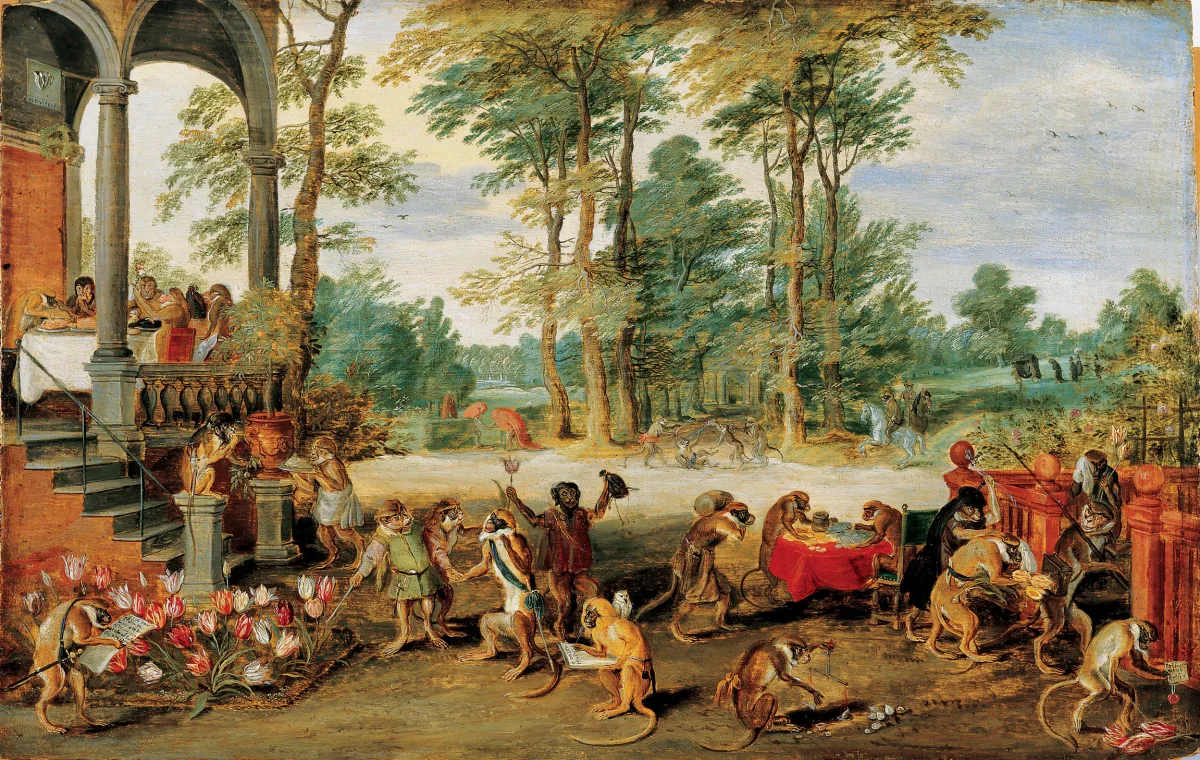
Look at Brueghel's painting again with that in mind. The monkeys weigh bulbs, count coins and feast on the terrace. On the right, one is being led before a judge, another relieves himself on the flowers that are now worthless, and a funeral procession disappears into the trees. It was painted around 1640 in Haarlem, the city where the colleges met, and it is 31 by 49 centimeters, a cabinet piece for a merchant's parlor. The joke was already fully formed three years after the crash. Mackay just translated it.
The flower outlived the joke. In 2023 Dutch growers planted more than 15,000 hectares of tulips, and the country exported flower bulbs worth over a billion euros in 2022, 320 million of it in tulips. And in Limmen, every spring, the Zomerschoon still comes up broken, virus and all, four hundred years on.
The timeline
-
1554
Ogier de Busbecq, Habsburg ambassador to the Ottoman court, sends tulip bulbs and seeds to Vienna.
-
1594
The first tulips flower in the Leiden botanical garden of Carolus Clusius. In 1596 and 1598 thieves raid the garden.
-
1624
A chronicler reports a Semper Augustus bulb valued at 1,000 guilders, twelve bulbs in existence, one owner.
-
Nov 1636
Prices for tulip contracts begin to climb in the tavern colleges of Haarlem, Amsterdam and other towns.
-
Feb 1637
A Haarlem sale finds no buyers on February 3. The Alkmaar estate auction days later brings about 90,000 guilders. Then the trade stops.
-
Apr 1637
The States of Holland suspend all tulip contracts. Courts refuse to enforce them.
-
May 1638
Haarlem lets buyers cancel contracts for 3.5 percent of the price. The bill for the mania is mostly never paid.
-
~1640
Jan Brueghel the Younger paints the traders as monkeys.
-
1841
Charles Mackay publishes Extraordinary Popular Delusions, seven pages on tulips, no sources. It becomes the standard version.
-
1928
Dorothy Cayley shows that "breaking" is an infection passed from bulb to bulb. The flames were a virus.
-
2007
Anne Goldgar publishes her archival study: 37 big spenders, no bankruptcies, no economic damage.
Sources
- Anne Goldgar, The Conversation 2018: Tulip mania: the classic story of a Dutch financial bubble is mostly wrong
- Smithsonian Magazine 2017: There Never Was a Real Tulip Fever
- Goldgar, A. (2007): Tulipmania: Money, Honor, and Knowledge in the Dutch Golden Age. University of Chicago Press.
- Dash, M. (1999): Tulipomania. Crown.
- Garber, P. M., Journal of Political Economy 1989: Tulipmania
- Thompson, E. A., Public Choice 2007: The tulipmania: Fact or artifact?
- McClure & Thomas, Financial History Review 2017: Explaining the timing of tulipmania's boom and bust
- Cayley, D. M., Annals of Applied Biology 1928: "Breaking" in tulips
- John Innes Centre: Why do tulips break?
- Fitzwilliam Museum, Cambridge: Tulipomania
- Rijksmuseum: Tulip book from the Six Collection
- Hortus Bulborum, Limmen
- Statistics Netherlands (CBS) 2024: Area used to grow bulbs up by more than a fifth since 2013
- Mackay, C. (1841): Memoirs of Extraordinary Popular Delusions, Project Gutenberg
*Affiliate link. As an Amazon Associate I earn from qualifying purchases.